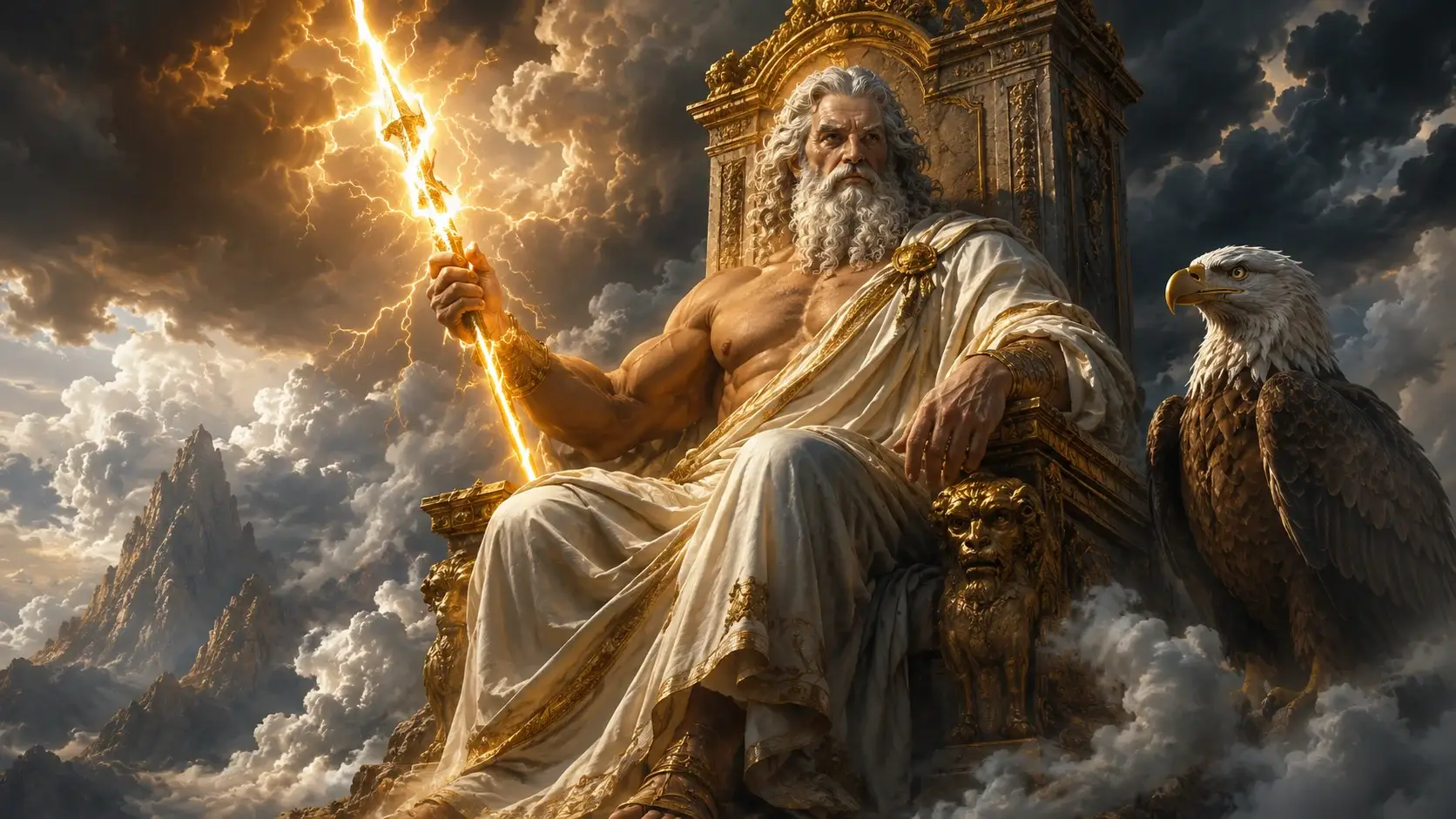
On the cloud-wreathed summit of Mount Olympus sat a god the whole of the ancient world looked up to — literally. When thunder broke over the Aegean, when an oath was sworn, when a stranger knocked at the door asking for shelter, the Greeks felt the same presence behind all of it: Zeus, father of gods and men, king of the sky.
But the most revealing thing about the greatest of the Greek gods is not his power. It is the question his myths keep circling: what does it mean for the keeper of cosmic order to be ruled, himself, by appetites he cannot master?
The Child Who Was Never Swallowed
Zeus was born into a prophecy of betrayal. His father, the Titan Cronus, had overthrown his own father — and feared the same fate so deeply that he swallowed each of his children whole the moment they were born. Five gods vanished into his gullet. When the sixth came, the mother-goddess Rhea had had enough. She hid the infant Zeus in a cave on Crete and handed Cronus a stone wrapped in swaddling clothes. He swallowed it without looking.
So the future king of heaven grew up in secret, suckled by the goat Amaltheia, his cries drowned out by dancing warriors clashing their shields — the whole cosmos hanging on a mother's desperate trick.
The War That Made a King
Grown and hidden no longer, Zeus forced Cronus to disgorge his swallowed siblings — Hades, Poseidon, Hera, Demeter, Hestia — alive and full-grown. Then came the Titanomachy, ten years of war that shook the world to its roots. Zeus freed the hundred-handed giants and the Cyclopes from the pit of Tartarus, and in gratitude the Cyclopes forged him the weapon that would define him forever: the thunderbolt. With the Titans cast down into Tartarus, the three brothers drew lots for the cosmos. Hades took the underworld, Poseidon the sea — and Zeus the sky, and with it dominion over all.
The Sky-Father's Justice — and His Hunger
Zeus was no mere storm-god. He was the guarantor of order: of sacred oaths (Zeus Horkios), of the bond between host and guest (Zeus Xenios), of kings and justice itself. To break faith with a stranger was to offend him directly. In this he is the moral spine of Greek religion.
And yet the same myths that crown him with justice are crowded with his infidelities — Metis, Leto, Leda, Danae, Europa, Semele, and dozens more, pursued in the shape of a swan, a bull, a shower of gold. Each affair seeds a hero or a god; each provokes the cold, patient fury of his wife, Hera. The Greeks did not flinch from this contradiction. Their highest god was both the upholder of order and its most habitual transgressor — power that writes the rules and then bends them.
The Blood of Zeus
From his unions and his will came the brightest of the divine and mortal worlds: grey-eyed Athena, sprung fully armed from his skull; the twins Apollo and Artemis; quicksilver Hermes; the twice-born Dionysus; and among mortals the mightiest heroes — Heracles and Perseus chief among them. To be a child of Zeus was to be marked for greatness and, just as often, for Hera's revenge.
Why Zeus Endures
Zeus is older than Greece. His name descends from the same ancient root as the Roman Jupiter and the Sanskrit Dyaus Pita — a primordial Indo-European Sky Father worshipped before Greece had a name. In him, a civilisation gave its sharpest expression to an eternal unease: that the one who holds ultimate power is the one least bound by the rules that power exists to keep.
When the thunder rolls over the mountains even now, some part of the old world still looks up — and remembers who is said to be watching.