Thor was the thunder-god of the Norse, the mightiest warrior of the Aesir and the great defender of both gods and mankind against the giants — red-bearded, enormously strong, wielder of the hammer Mjölnir, and the most beloved of all the gods to the common people of the Viking age. Where his father Odin was the god of kings, poets and the cunning few, Thor was the god of the farmer and the sailor, the protector who stood between the world and the forces of chaos.
The Thunderer
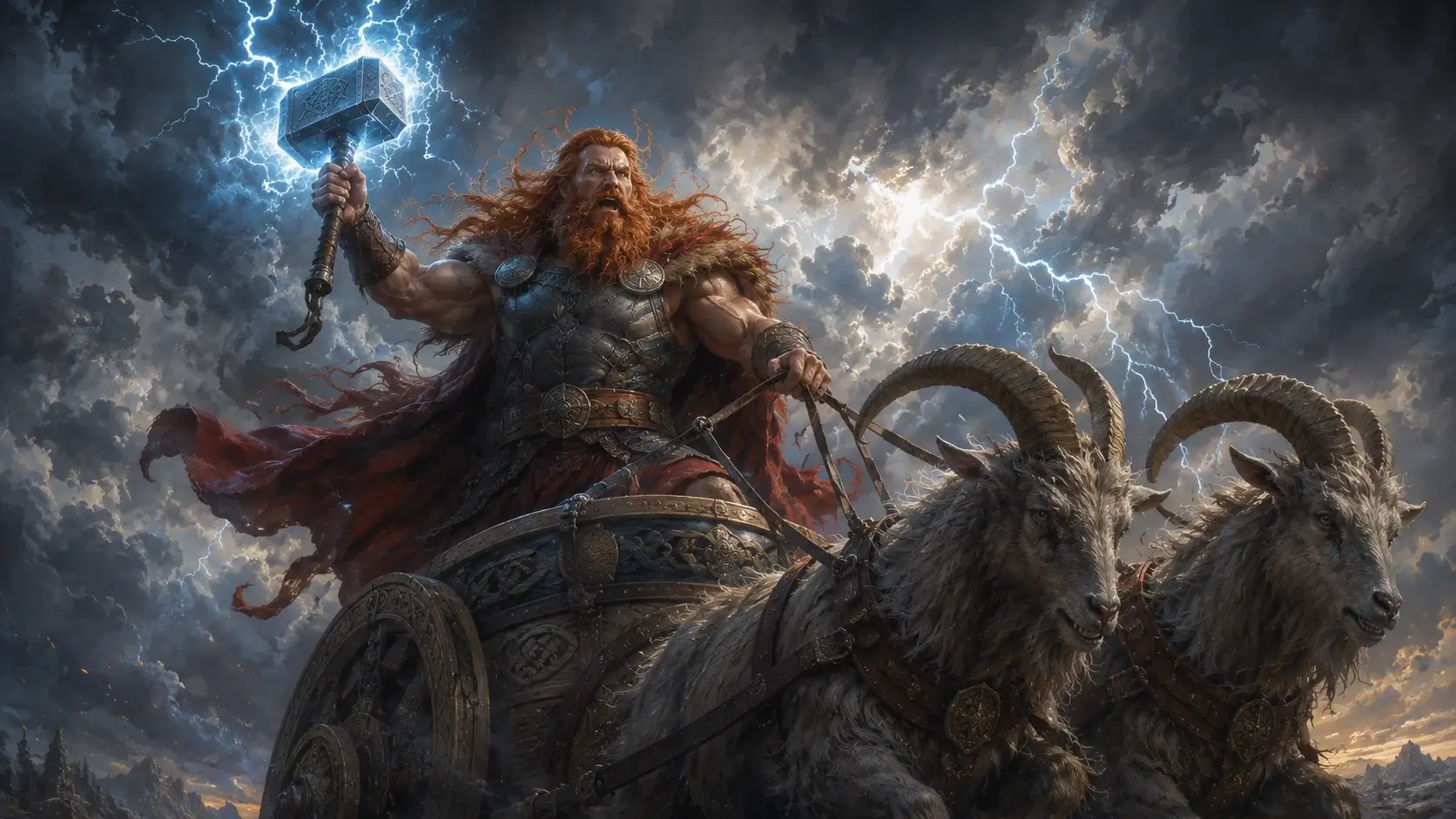
Thor (Old Norse &Th;órr; the same god the continental Germans called Donar, “thunder”) was a son of Odin and the earth-goddess Jord, and the strongest of all the gods. He was the god of thunder, lightning, storms and the sky, and the bringer of the rains that made the crops grow — so that he was at once a god of awesome power and a god of fertility and protection. He was imagined as a huge, red-bearded man of vast appetite and quick temper, riding across the heavens in a chariot drawn by two goats, Tanngrisnir and Tanngnjóstr, whose passage made the thunder roll. The very days of our week remember him: Thursday is “Thor's day.”
Mjolnir, the Hammer
Thor's great weapon was the hammer Mjölnir, forged by the dwarves, which never missed its mark and always returned to his hand when thrown. With it he was the unstoppable champion of the gods, the slayer of giants and the bane of the great serpent. He also wore a belt of strength, Megingjörð, which doubled his already immense power, and iron gloves to grip the hammer's short handle. Mjolnir was more than a weapon: it was a sacred symbol of protection and blessing, used to hallow marriages and funerals, and Vikings wore it as an amulet against harm — the great hammer that warded off the chaos of the giants.
The Foe of the Giants
Thor's endless task was to defend Asgard and Midgard against the jötnar (giants), the forces of chaos that forever threatened to overwhelm the ordered world. The myths are full of his journeys into the giants' lands and his battles with their champions: he crushed the skull of the giant Hrungnir; he fished for the world-serpent itself from the boat of the giant Hymir, hauling up Jörmungandr on his line; he was tricked and tested in the hall of Utgarða-Loki, where he wrestled old age itself and tried to drain the sea. Again and again, often with the trickster Loki as his uneasy companion, Thor was the muscle that kept the giants at bay.
The Theft of the Hammer
In one of the most beloved and comic of the myths, the giant Thrym stole Mjölnir and demanded the goddess Freya as his bride in ransom. The solution was for Thor himself to dress as the bride, veiled, with Loki as his bridesmaid — and when the hammer was brought out to bless the wedding, Thor seized it and slaughtered the whole giant hall. The tale shows the other side of the thunder-god: not only awesome but earthy, robust and the hero of a good rough joke.
The Doom at Ragnarok
At Ragnarök, the end of the world, Thor is fated to meet his greatest enemy at last: the world-serpent Jörmungandr, the monstrous child of Loki that encircles the earth. The two will destroy each other — Thor will slay the serpent with his hammer, but will be able to stagger only nine steps before falling dead from its venom. Thus the mightiest defender of the world dies defending it to the very end, killing the great enemy with his last strength. Thor endures as the very image of protective strength, the people's god who stood guard over the world; his hammer remains one of the most powerful and beloved symbols of the entire Norse age.
The hammer that warded the world from chaos struck down the world-serpent at the last — and its bearer walked nine steps and fell, having defended the earth to his final breath.