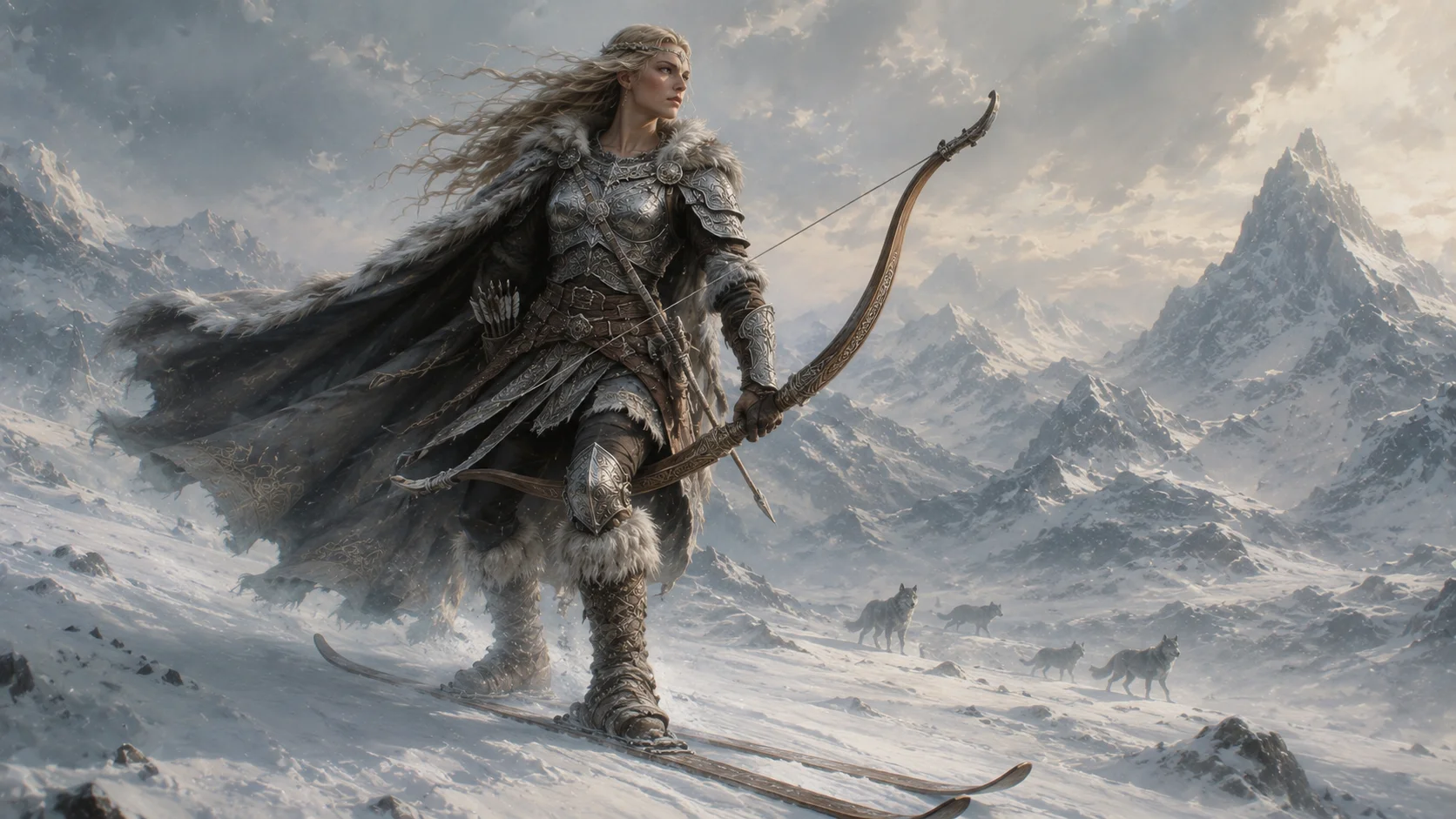
Skadi was the Norse goddess of winter, the mountains, skiing and the hunt — a giantess who became a goddess of the Aesir, striding the high snowy peaks on skis with her bow, a fierce and independent huntress born of the cold. Her story of vengeance, marriage and parting is one of the most vivid in Norse myth, and she remains the very spirit of the frozen northern wilds.
The Snowshoe Goddess
Skadi (Old Norse Skaði) was a jötunn, a giantess, the daughter of the giant Thiazi — yet she came to be counted among the goddesses of Asgard. She was the deity of winter, of the high snow-covered mountains, of bowhunting and of skiing or snowshoeing across the frozen heights; she was often called the “snowshoe goddess” or “ski-goddess.” Strong, self-reliant and warlike, she belonged to the cold uplands and the harsh beauty of the northern winter, a goddess who needed no one and went armed and alone through the snows with her hunting-bow.
The Vengeance for Her Father
Skadi's tale begins in grief and fury. When the gods killed her father Thiazi (the giant who had abducted Idun), Skadi armed herself in full war-gear and marched alone to Asgard to take vengeance on the gods. Rather than fight her, the Aesir offered her recompense — and Skadi, formidable enough to bargain with the gods themselves, set her own terms: she demanded a husband from among the gods, and she demanded that the gods make her laugh, for grief had frozen her heart.
The Marriage by the Feet
The gods agreed to let Skadi choose a husband — but only by looking at the gods' feet, their faces hidden. Hoping to win the radiant Baldr, Skadi chose the most beautiful pair of feet — only to find they belonged to the old sea-god Njord. As for the laughter, Loki won it with a piece of crude buffoonery, tying his beard to the beard of a goat and engaging in an absurd tug-of-war until, shrieking, he tumbled into Skadi's lap — and at last the grim giantess laughed. Her father's death was further atoned when Odin (or Thiazi's eyes) was set among the stars. But the marriage to Njord was doomed: Skadi loved the howling wolves and the snowy peaks, while Njord loved the gulls and the seashore, and neither could bear the other's home. In the end the winter-goddess returned alone to her beloved mountains, to ski and hunt among the snows.
The Spirit of the Winter Wilds
Skadi endures as one of the most striking goddesses of Norse myth — the giantess who bargained with the gods as an equal, the fierce huntress of the winter mountains, independent and unbowed. Some scholars connect her very name to Scandinavia itself, the “land of Skadi.” She embodies the Norse reverence for the harsh, beautiful winter wilderness and the ideal of the strong, self-possessed woman who lives by her own terms, owing nothing, striding the high snows with her bow.
She came to Asgard armed and alone to avenge her father, bargained with the gods as an equal, and in the end chose the silent snowy peaks over any husband — the goddess of winter, who needed no one.