Ra was the sun-god of ancient Egypt and the king of the gods — the radiant creator who sailed his solar barque across the sky each day and through the perilous underworld each night, doing battle with the serpent of chaos so that the sun might rise again at dawn. For three thousand years he was the supreme deity of Egypt, the god whose journey was the very rhythm of life, death and rebirth that ordered the cosmos.
The Sun and the Creator
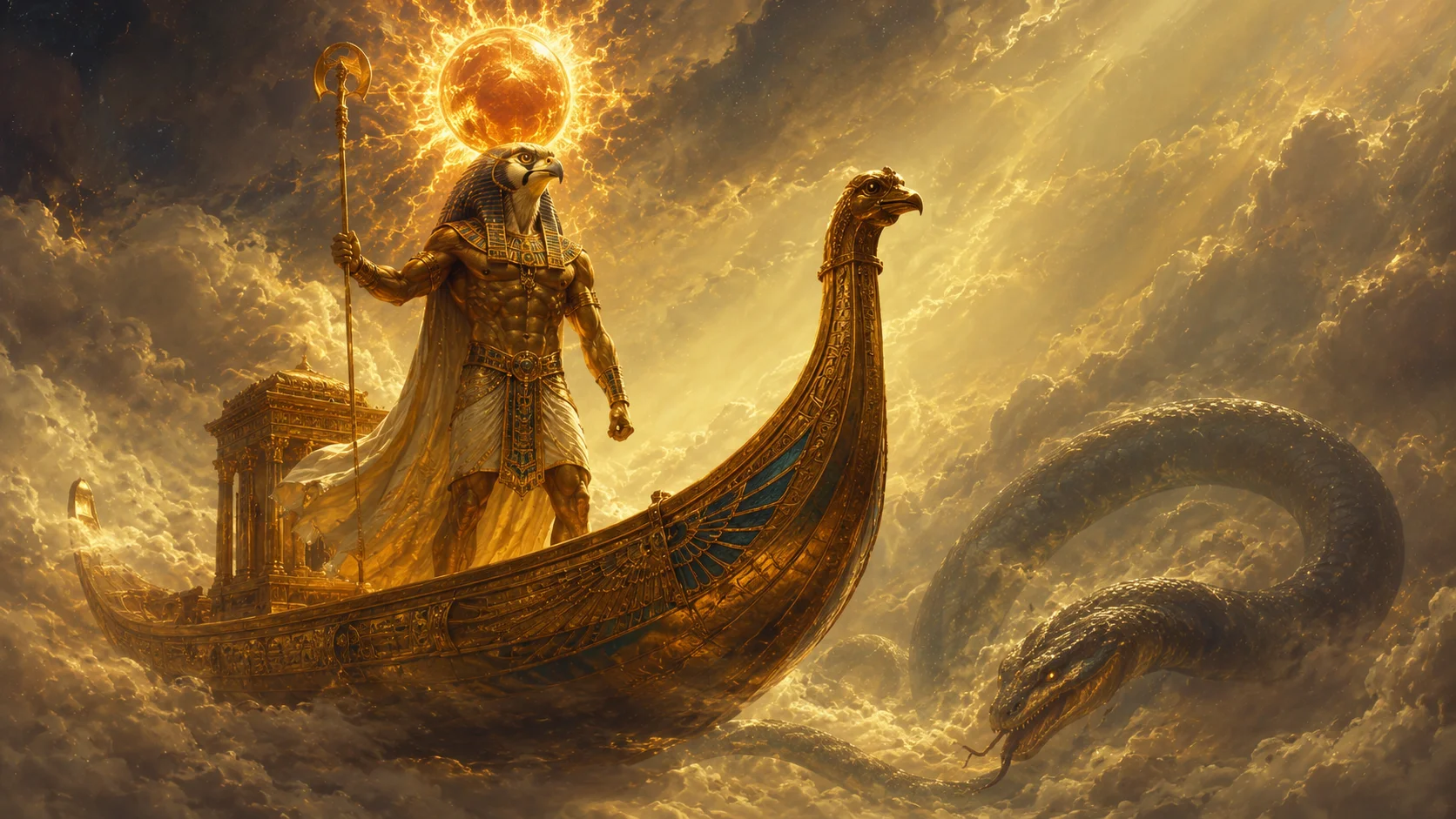
Ra (also Re) was the personification of the sun at its full noonday strength, and the chief of the Egyptian gods. In the great creation-myth of Heliopolis, the sun-god (as Atum-Ra) was the self-created first being who rose from the primordial waters of Nun upon the first mound of earth and brought forth the first gods, beginning creation. He was the source of all light, warmth and life, the king who ruled gods and men in the first ages of the world, and the divine ancestor of the pharaohs, who styled themselves “Son of Ra.” He was depicted as a man with the head of a falcon crowned with the solar disc, encircled by a sacred cobra.
The Voyage of the Solar Barque
Ra's defining act was his eternal journey across the sky. Each day he sailed from east to west in his solar barque, the Boat of Millions of Years, bringing daylight to the world — appearing at dawn as the scarab-god Khepri, blazing at noon as Ra, and setting in the evening as the ram-headed Atum in his old age. At nightfall he entered the Duat, the underworld, and sailed through its twelve dark hours — a perilous voyage through the realm of the dead, where he brought light and life to the dead as he passed, before rising renewed at dawn. The daily cycle of the sun was, to the Egyptians, this literal voyage of the god, the endless round of death at dusk and rebirth at dawn.
The Battle with Apophis
Each night, in the depths of the underworld, Ra faced his great enemy: Apophis (Apep), the colossal serpent of chaos and darkness, who lay in wait to swallow the sun and end the world. Every night the serpent attacked the solar barque, and every night Ra and his defenders (including the god Set, who stood at the prow with his spear) fought and defeated Apophis, cutting and binding the serpent so that the sun could continue its journey and rise again. This nightly battle was the cosmic struggle of order against chaos, light against darkness, played out anew every single night — and the rising of the sun each dawn was the daily victory of Ra over the forces that sought to destroy creation.
The Eye of Ra and the Aging God
Ra possessed a fearsome power in the Eye of Ra — a feminine personification of the sun's destructive heat, sent out as a goddess (often Hathor or Sekhmet) to punish the enemies of the god. In one famous myth, when mankind plotted against the aging Ra, he sent the Eye as the lioness Sekhmet to slaughter humanity, and she nearly destroyed the human race before being pacified. For Ra, in the myths, grew old — his bones turned to silver, his flesh to gold — and in his old age the cunning Isis tricked him into revealing his secret name, gaining power over him. Eventually the aged sun-god withdrew from the earth, rising into the sky on the back of the sky-goddess Nut, leaving the rule of Egypt to his successors.
The Lord of the Sun
Ra endures as the supreme god of ancient Egypt and one of the great solar deities of all mythology — the radiant creator, the king of the gods, the sailor of the sky and the underworld, the eternal foe of the chaos-serpent. He embodies the Egyptian vision of the cosmos as a daily and eternal cycle of death and rebirth, of the constant struggle to maintain order against chaos, and of the sun itself as the visible body of the greatest of the gods, sailing forever across the sky and through the dark, rising anew each dawn.
Each night he sails into the realm of the dead and fights the serpent of chaos for the life of the world — and each dawn, his victory is written across the sky as the rising sun.