
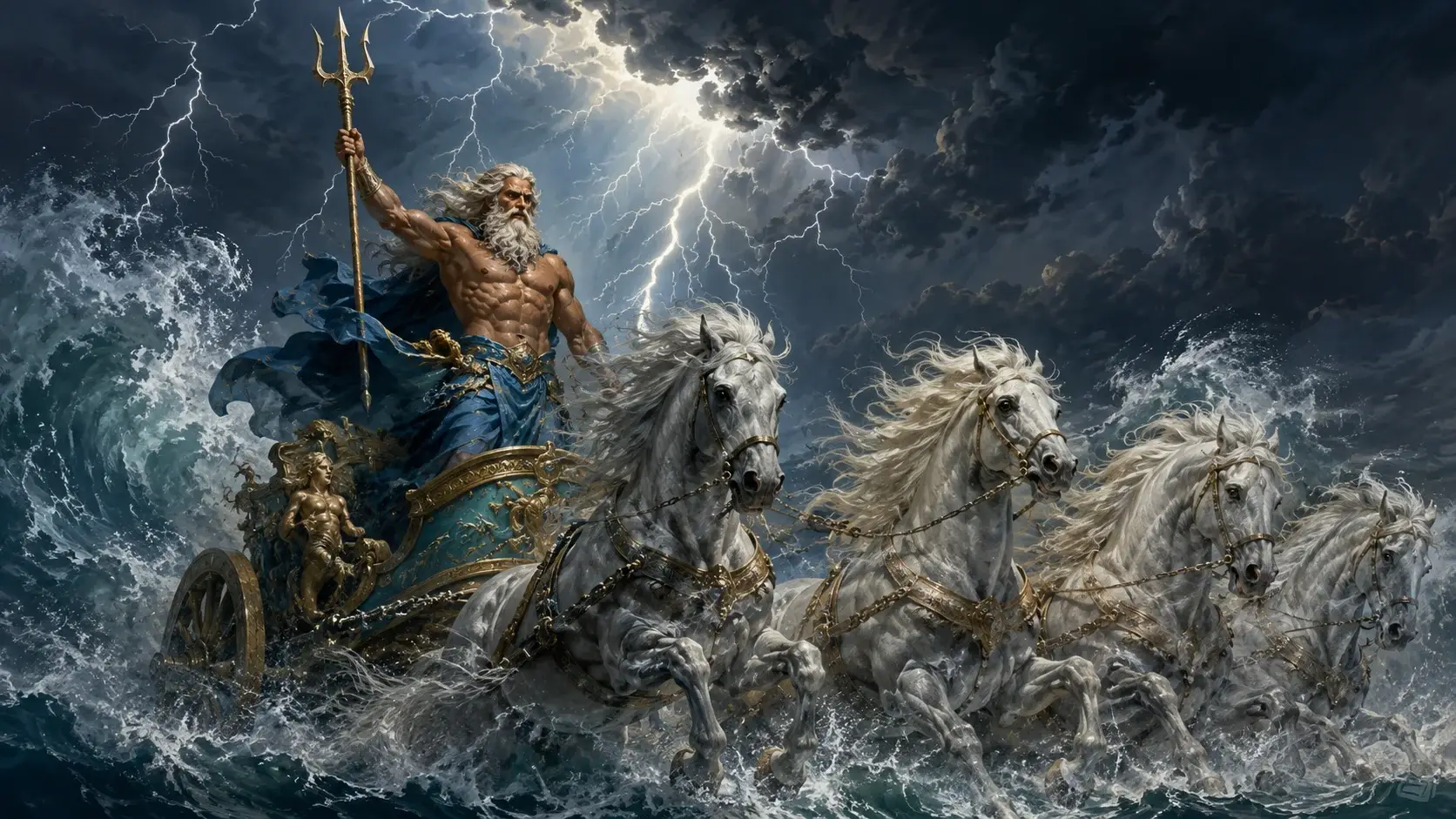
The Greeks who put to sea did so knowing their lives belonged to one god above all others — a god as changeable as the water itself, generous and beautiful one hour, annihilating the next. Poseidon, lord of the sea, earth-shaker, tamer and maker of horses, was perhaps the most feared of all the Olympians, because his domain was the one the Greeks could neither live without nor ever truly trust.
The Brother Who Drew the Sea
When the three sons of Cronus — Zeus, Hades and Poseidon — divided the cosmos by lot after the fall of the Titans, Poseidon drew the waters of the world. But to call him merely a sea-god undersells him. His older, deeper title is Enosichthon, the Earth-Shaker: the Greeks blamed earthquakes on the blow of his trident, and so his power reached far beyond the shoreline into the trembling ground itself.
Earth-Shaker, Storm-Bringer, Horse-Lord
With a single gesture of his three-pronged trident, Poseidon could raise storms that shattered fleets or calm the water to glass. He was also, strangely and wonderfully, the god of horses — Poseidon Hippios — said to have created the first horse and to father divine steeds. The Greeks linked the surge of breaking waves to the gallop of white horses, and in that image sea and stallion became one.
The Contests and the Grudges
Poseidon's pride made him a dangerous rival. When he and Athena both desired the great city of Attica, each offered a gift: Poseidon struck the Acropolis and brought forth a saltwater spring (or a horse), but Athena's olive tree won the people, and the city became Athens. He never quite forgave the slight.
His grudges could doom a man for a generation. When the hero Odysseus blinded the Cyclops Polyphemus — Poseidon's own son — the sea-god scattered his ships and kept him from home for ten long years. It was in a temple of Poseidon, too, that Medusa drew Athena's curse. To cross the Earth-Shaker, or even to be caught in his orbit, was to invite the sea to swallow you.
The Untrustworthy Deep
Poseidon endures because he is the face the Greeks gave to the sea's double nature: the road to every island and colony, the source of food and trade and empire — and the vast, indifferent thing that could erase a ship and its crew without a ripple of remorse. To honour Poseidon was not to love him. It was to bargain, carefully, with a power you could never command.
Sailors poured wine into the waves before every voyage — not in worship, but in the oldest kind of prayer: please, let me cross, and let me come home.