Pollux — Polydeuces in Greek — was the immortal half of the divine twins the Dioscuri, and the brother whose boundless love for his mortal twin Castor gave their myth its unforgettable ending. A son of Zeus and a champion boxer, his story is the same as Castor's, but told from the side of the one who could not die — and could not bear to live alone.
The Immortal Twin
Pollux was the son of Zeus, who came to Leda in the form of a swan; his twin Castor was the son of Leda's mortal husband. Thus Pollux was born immortal, Castor mortal — a fateful difference between two brothers who were otherwise inseparable. Pollux was famed as the greatest boxer of the heroic age, just as Castor was the greatest horseman; together the Dioscuri were a matched pair of champions.
The Adventures of the Dioscuri
With his brother, Pollux joined the voyage of the Argonauts, where his fists won glory: he defeated and killed the brutal king Amycus, a giant who forced all strangers to box him to the death, in a famous bout. The twins were honoured everywhere as protectors of sailors in storms, guardians of guests and oaths, and patrons of athletic games.
The Choice of Love
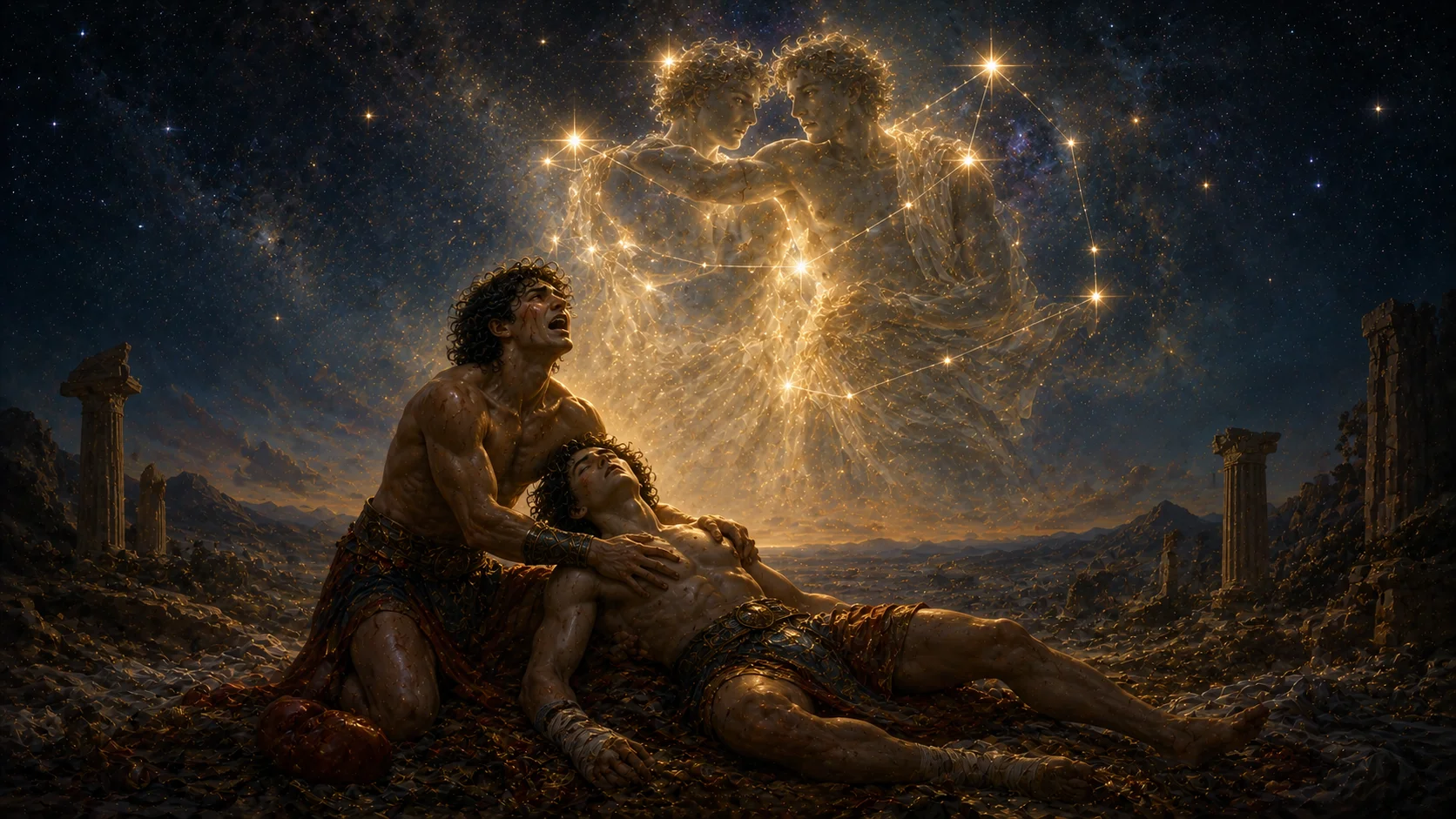
The defining moment of Pollux's story is his grief. When his mortal brother Castor was killed in a fight, Pollux was destroyed by sorrow. As an immortal, he could not follow his brother into death — and the prospect of eternal life without Castor was unbearable to him. He prayed to his father Zeus, begging either to bring Castor back or to let himself die too. Zeus, moved by a love so great that a god would renounce immortality for it, offered a compromise: Pollux could share his own immortality with his brother, the two of them alternating between Olympus and the underworld — together for eternity, on either side of death. Pollux accepted at once. He gave away half of his own deathlessness rather than spend a single day apart from his brother.
The Brothers Forever
For this, Zeus honoured the twins among the stars as Gemini, and they became the beloved patron gods of sailors, appearing as the twin flames of St Elmo's fire to promise safe passage. Pollux's story is the heart of the Dioscuri myth: the immortal who proved that even endless life is worth nothing without the one you love beside you.
Offered eternity, he gave half of it away — because eternity without his brother was not worth having.