Orpheus was the greatest musician who ever lived — a poet and lyre-player whose songs could charm beasts, move stones, and bend rivers from their course. But his fame rests on the most heartbreaking journey in all of Greek myth: the day he walked into the land of the dead to bring back the woman he loved, and lost her at the very last step.
The Voice That Moved the World
Son of the Muse Calliope, Orpheus played the lyre given to him by Apollo with such divine skill that nothing in nature could resist it. Wild animals lay down to listen; trees uprooted themselves to gather near; even the rocks and rivers stilled to hear him. Aboard the Argo, his music drowned out the deadly song of the Sirens and saved the Argonauts. His was the power of art to enchant all of creation.
The Descent for Eurydice
When his beloved wife Eurydice died of a snakebite, Orpheus did the unthinkable: he walked living into the underworld to win her back. He played his lyre before Hades and Persephone themselves — and his grief was so beautiful that the rulers of the dead wept, and the wheel of Ixion stopped, and for the first time the iron hearts of the underworld softened. They granted his wish: Eurydice could follow him back to the world of the living.
The Backward Glance
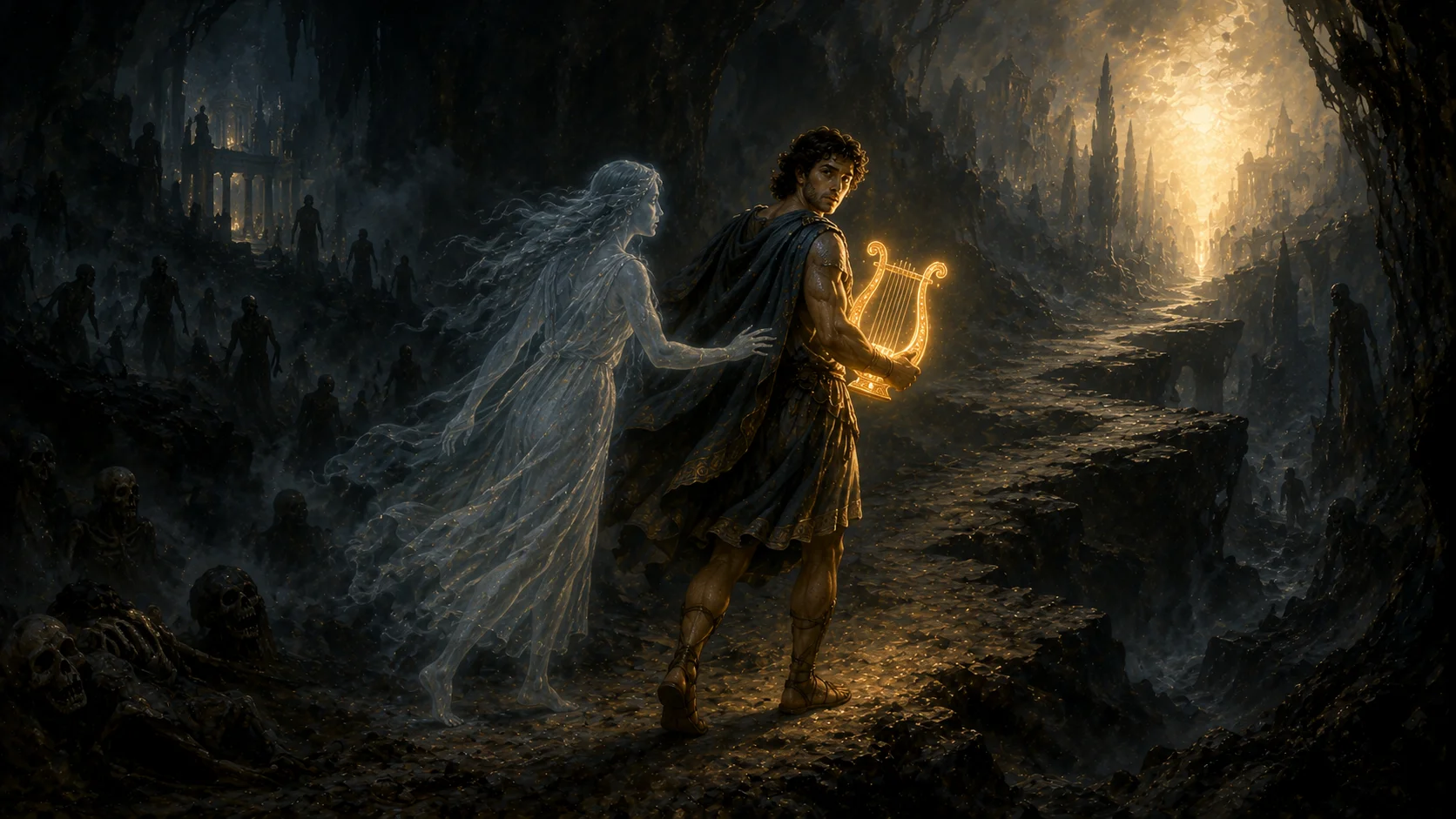
But there was one condition: he must walk ahead and not look back at her until both had reached the sunlight. Orpheus climbed the long dark path, hearing nothing behind him, tormented by doubt — was she truly there? At the very threshold of the light, unable to bear it, he turned. And there she was — for an instant — before she slipped back into the dark forever, with only a faint, final “farewell.” He had lost her twice, the second time by his own hand.
The Price of Looking Back
Orpheus is the eternal story of love against death — of how close we can come to undoing the unundoable, and how a single moment of doubt can cost us everything. His myth asks the cruellest question: when love and faith are tested at the last step, can any heart truly hold its nerve?
He charmed even death into mercy — and then could not trust it for the length of one last walk into the light.