Odin was the All-Father, the one-eyed king of the Norse gods and the ruler of Asgard — god of war and death, of wisdom and poetry, of magic and prophecy, and of the frenzy that gives him his name. Restless, terrible and unfathomable, he is the most complex deity in all of Norse myth: a god who sacrificed his eye for wisdom, hanged himself to win the runes, and raises the slain into his hall to fight beside him at the end of the world.
The All-Father
Odin (Old Norse Óðinn, from a root meaning “fury,” “frenzy,” “inspiration”) was the chief of the Aesir, the foremost of the gods, and was called All-Father because he was reckoned the father of gods and, in a sense, of mankind. With his brothers Vili and Ve he slew the primordial giant Ymir and shaped the world from his body; and from two pieces of driftwood, Ask and Embla, the brothers fashioned the first man and woman, with Odin giving them the breath of life. He ruled from his high seat Hlidskjalf, from which he could see across all the Nine Worlds.
The Seeker of Wisdom
What set Odin apart from every other king of gods was his insatiable, sacrificial hunger for knowledge. He gave up one of his eyes, casting it into the well of the giant Mimir, in exchange for a single drink of its waters of wisdom — and so the All-Father is forever one-eyed, having traded sight for insight. Greater still, he hanged himself upon the world-tree Yggdrasil for nine nights, pierced by his own spear, “given to Odin, myself to myself,” in order to win the secret of the runes — the magical letters of power and prophecy. No price was too high for him in his quest to know.
God of War and the Slain
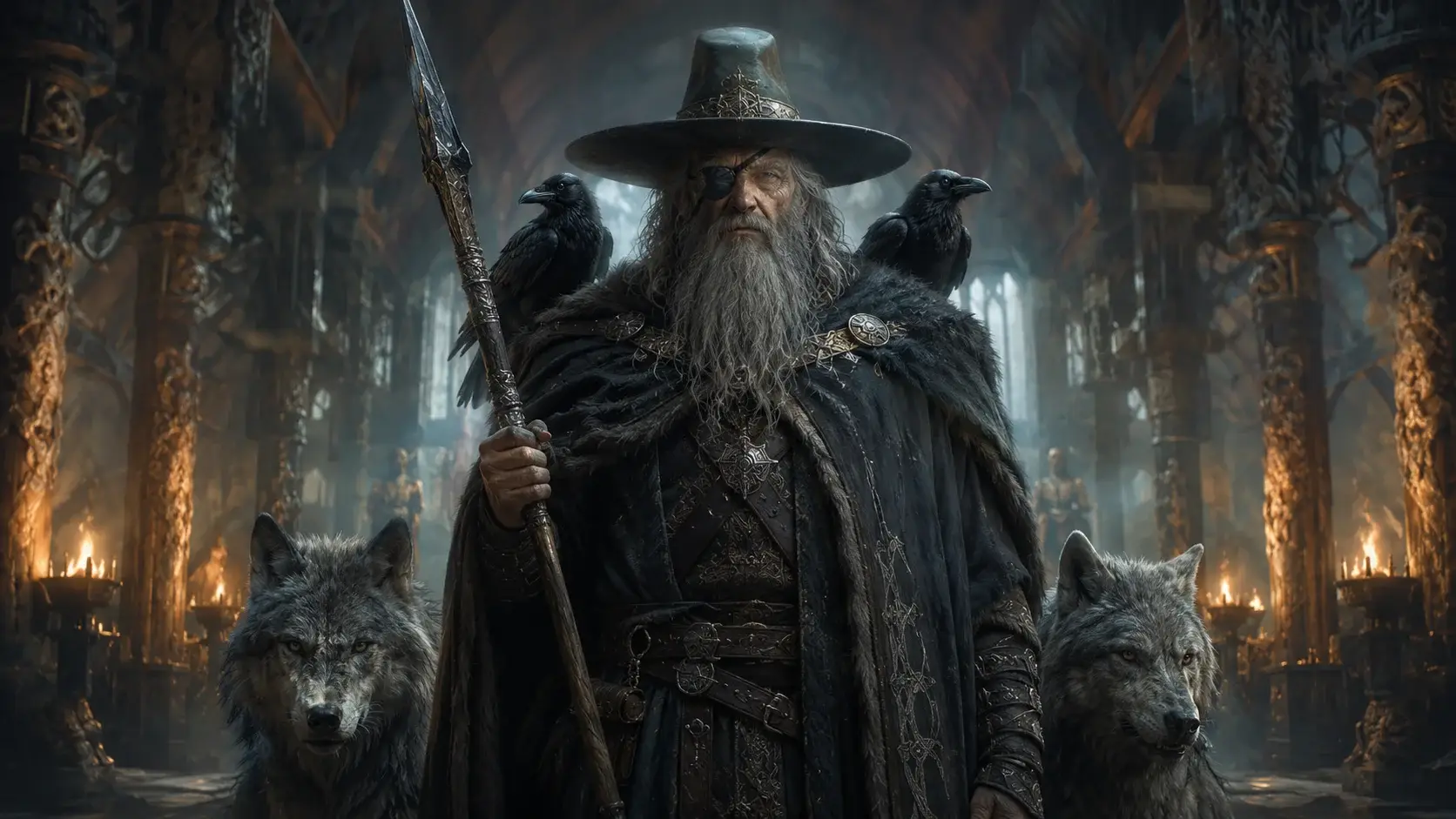
Odin was a god of war, but not of the honest battle-rage of his son Thor; his was the war of cunning, frenzy and the chooser of the slain. From his hall Valhalla, the “hall of the slain,” he sent out the Valkyries to gather the bravest warriors who fell in battle — the Einherjar — who feast and fight in his hall each day, kept ready for the final war. He was attended by two ravens, Huginn (Thought) and Muninn (Memory), who flew across the world each day and whispered all they saw into his ears; by two wolves, Geri and Freki; and he rode the eight-legged steed Sleipnir and wielded the spear Gungnir, which never missed. He was also a wandering god, often appearing among mortals as a grey-bearded traveler in a broad hat and cloak, testing and deceiving men.
Master of Magic and Poetry
Odin was the master of seidr, a powerful form of Norse magic and prophecy (though it was considered unmanly, a sign of how far he would go for power), and the patron of poets, for he won for the gods the Mead of Poetry, the drink that grants the gift of verse and wisdom. He was thus the god of every kind of inspiration — the battle-frenzy of the berserker, the ecstasy of the poet, the trance of the seer — all of them forms of the divine fury that was his very name.
The God Who Knows His Doom
Odin's deepest characteristic is that he knows the future and knows it to be hopeless. He has foreseen Ragnarök, the doom of the gods, and knows that he himself is fated to be devoured by the great wolf Fenrir on that last day — and yet he spends all his cunning and all his sacrifice preparing for a battle he knows he will lose, gathering his army of the slain against the inevitable. This tragic, clear-eyed defiance is the heart of the Norse spirit: to fight on with courage even in the certain knowledge of defeat.
One-eyed, spear in hand, ravens on his shoulders, the All-Father gathers his fallen army for a war he has already seen himself lose — and arms anyway.