Deep beneath the palace of Knossos, in a maze so cunning that no one who entered could ever find the way out, something waited in the dark: the Minotaur, a creature with the body of a man and the head of a bull, hungry for human flesh. It is one of myth's most primal nightmares — the monster at the centre of the labyrinth, and the children sent into the dark to feed it.
Born of a Curse
The Minotaur's origin was a divine punishment. King Minos of Crete had refused to sacrifice a magnificent white bull to Poseidon, so the god cursed Minos's wife, Pasiphae, with an unnatural passion for the animal. From their union was born the Minotaur — named Asterion — a shameful, monstrous child that was neither beast nor man. Unable to kill it and unable to bear the sight of it, Minos had the master craftsman Daedalus build the Labyrinth: a maze so complex that the monster could never escape, and neither could anyone sent in to it.
The Tribute of Flesh
To feed the beast — and to punish Athens for a past wrong — Minos demanded a horrific tribute: every nine years, seven youths and seven maidens of Athens were sent into the Labyrinth to be devoured. It is one of the cruellest images in Greek myth: innocents walking into the dark, the door sealing behind them, the thing waiting at the heart of the maze.
The Thread in the Dark
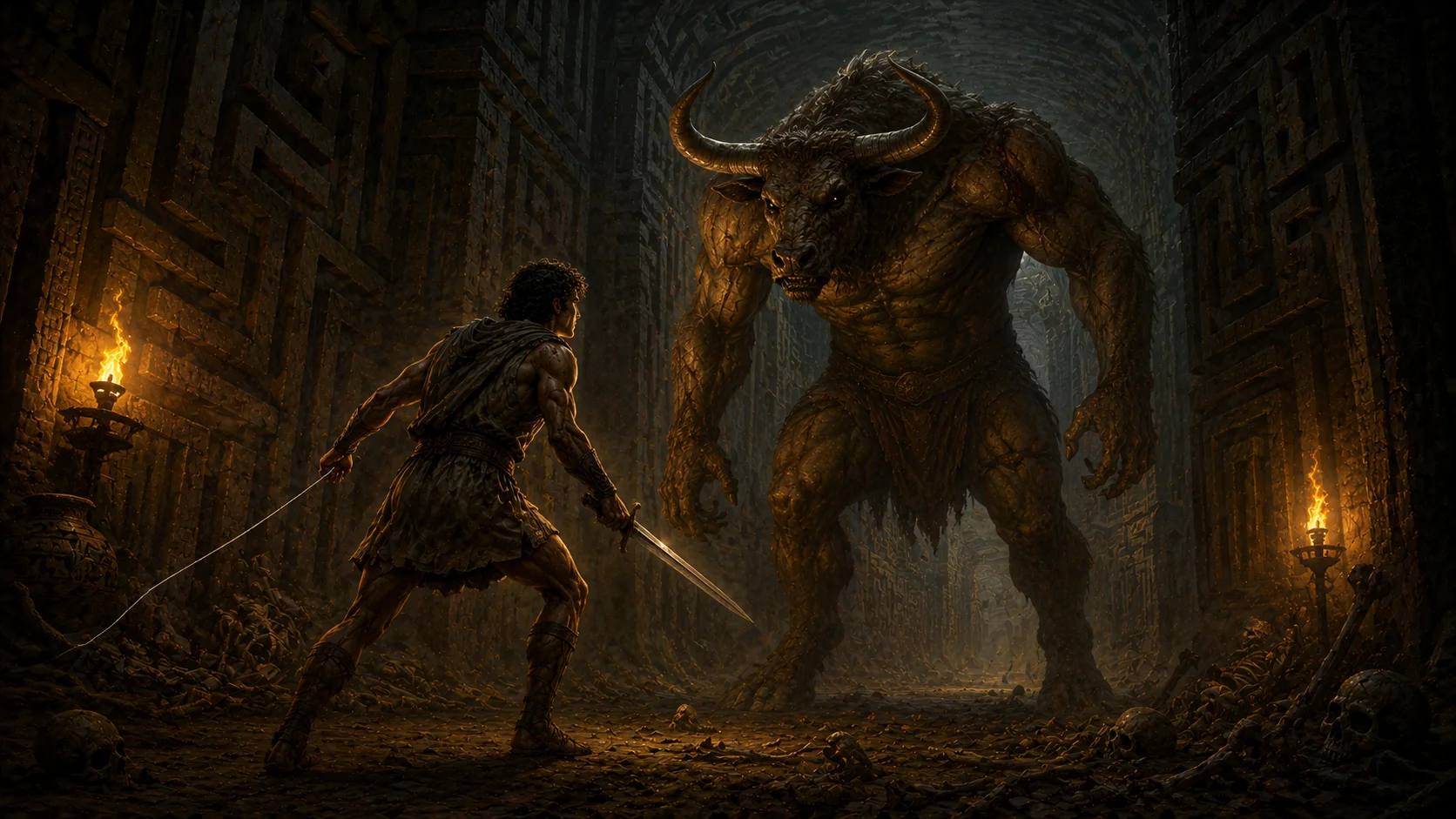
The hero Theseus volunteered as one of the tributes, determined to end it. Minos's own daughter Ariadne, fallen in love with him, gave him a ball of thread to unwind as he went, so he could find his way back. Deep in the maze Theseus found the Minotaur and killed it with his bare hands (or a hidden sword), then followed the thread back to the light. The monster fell — but the deeper terror, the maze itself, is the part we never forget.
We still speak of being “lost in a labyrinth,” and of the thread that leads us out — both gifts of this single, shadowed myth.