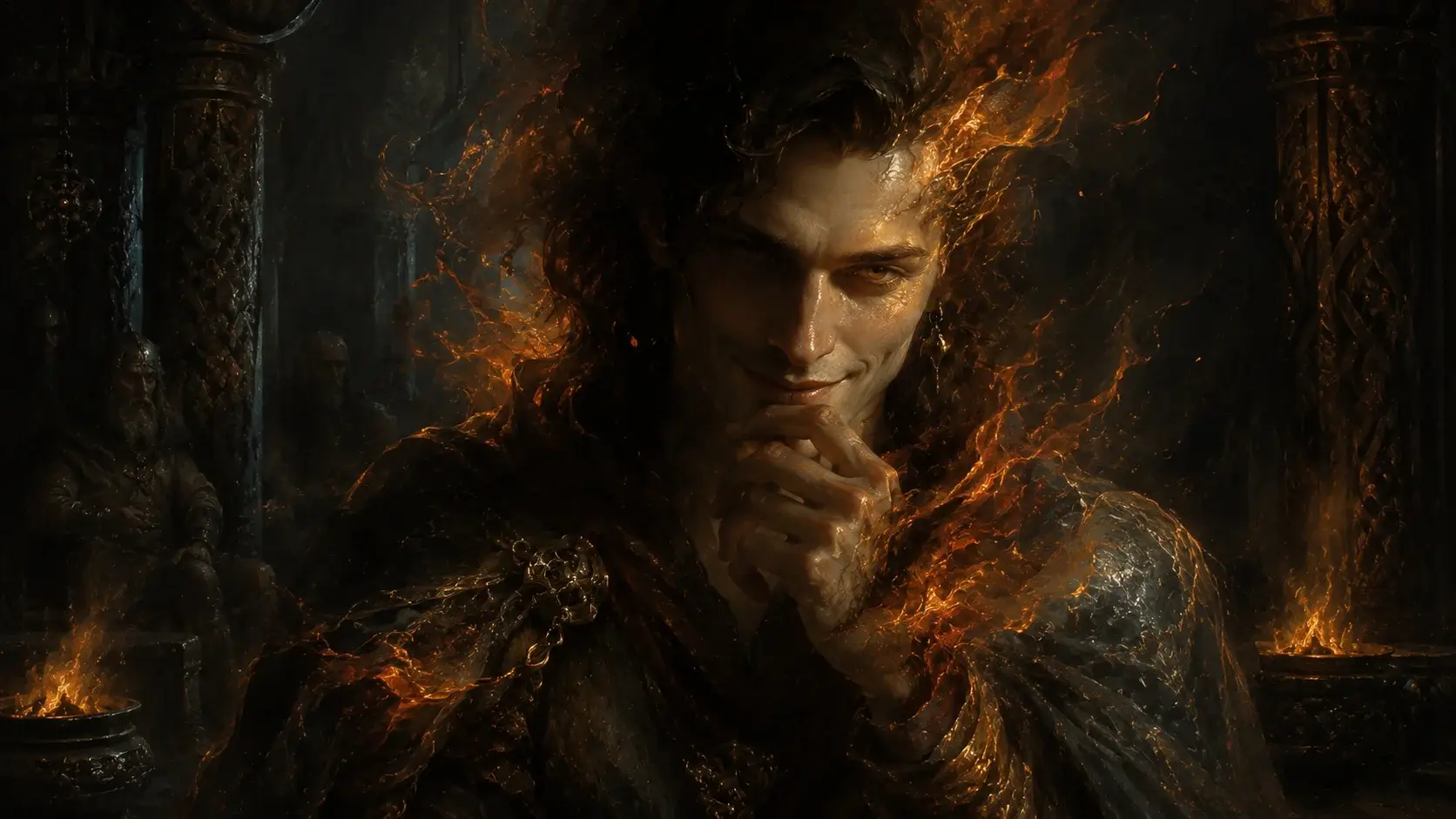
Loki was the trickster of the Norse gods — a shape-shifting, silver-tongued being of giant blood who lived among the Aesir as Odin's blood-brother, at once their cleverest helper and their most dangerous enemy. Charming, cunning and utterly amoral, he is the spark of mischief that drives half the myths and the engine of catastrophe that brings about the end of the world. No figure in Norse myth is more fascinating or more impossible to pin down.
The Trickster Among the Gods
Loki (Old Norse Loki) was the son of the giant Farbauti and Laufey, and so by blood one of the jötnar, the giants who were the enemies of the gods — yet he dwelt in Asgard as a sworn blood-brother of Odin and a companion of the gods, especially of Thor. He was a being of contradictions: handsome and persuasive, brilliant and resourceful, but faithless, malicious and ruled by his own whims. He had the power to change his shape into anything — a salmon, a mare, a fly, an old woman — and his cleverness repeatedly got the gods both into and out of trouble.
Helper and Schemer
Much of the time Loki's tricks served the gods, or at least repaired the damage his own mischief had caused. When he cut off the golden hair of Thor's wife Sif as a cruel joke, it was his scheming that won from the dwarves not only new golden hair but the gods' greatest treasures — Odin's spear Gungnir, Thor's hammer Mjölnir, Frey's ship and golden boar. When a giant builder threatened to claim Freya, the sun and the moon as payment, it was Loki who, transforming into a mare, lured away the builder's mighty stallion — and so gave birth, himself, to Odin's eight-legged horse Sleipnir. Time and again he was the gods' problem-solver, even when the problem was his own making.
The Father of Monsters
By the giantess Angrboda, Loki fathered three terrible children who would become the doom of the gods: the great wolf Fenrir, fated to devour Odin; the world-serpent Jörmungandr, fated to kill Thor; and Hel, the goddess who rules the realm of the dead. Through these monstrous offspring, Loki is the ancestor of the very forces that will destroy Asgard — the enemy bred within the household of the gods.
The Murder of Baldr
Loki's mischief darkened into true evil with the death of Baldr. Out of envy and malice, he discovered the one thing that could harm the invulnerable god — the mistletoe — fashioned it into a dart, and guided the blind god Hodr's hand to kill Baldr with it. Then, when all the world wept to bring Baldr back from the dead, Loki alone — disguised as the giantess Thokk — refused to weep, and so doomed Baldr to remain among the dead forever. With this, Loki passed from troublesome trickster to the murderer of the best of the gods.
The Binding and Ragnarok
For his crimes, and for the cruel mockery he heaped on the gods at a final feast, the Aesir hunted Loki down (catching him in salmon form) and bound him in a cave with the entrails of his own son, with a venomous serpent dripping poison onto his face. His faithful wife Sigyn holds a bowl to catch the venom, but when she turns to empty it, the poison falls and Loki writhes so violently that the earth quakes. There he is fated to remain until Ragnarök — when he will break free, steer the ship of the dead, and lead the giants and monsters against the gods, meeting his old foe Heimdall in a battle where each slays the other. Loki endures as one of mythology's great tricksters, the necessary chaos within the divine order, the friend who becomes the destroyer.
Blood-brother to Odin, father of the wolf that eats him — Loki was the chaos the gods kept close, until the day it broke its bonds and brought the world down.