Idun was the Norse goddess of youth and rejuvenation — the keeper of the golden apples of immortality on which the gods depended for their eternal youth. Without her apples the Aesir would wither and grow old like mortals, and so her brief abduction by a giant brought the gods to the very edge of decay, in one of the most revealing of all the Norse myths.
The Keeper of the Apples
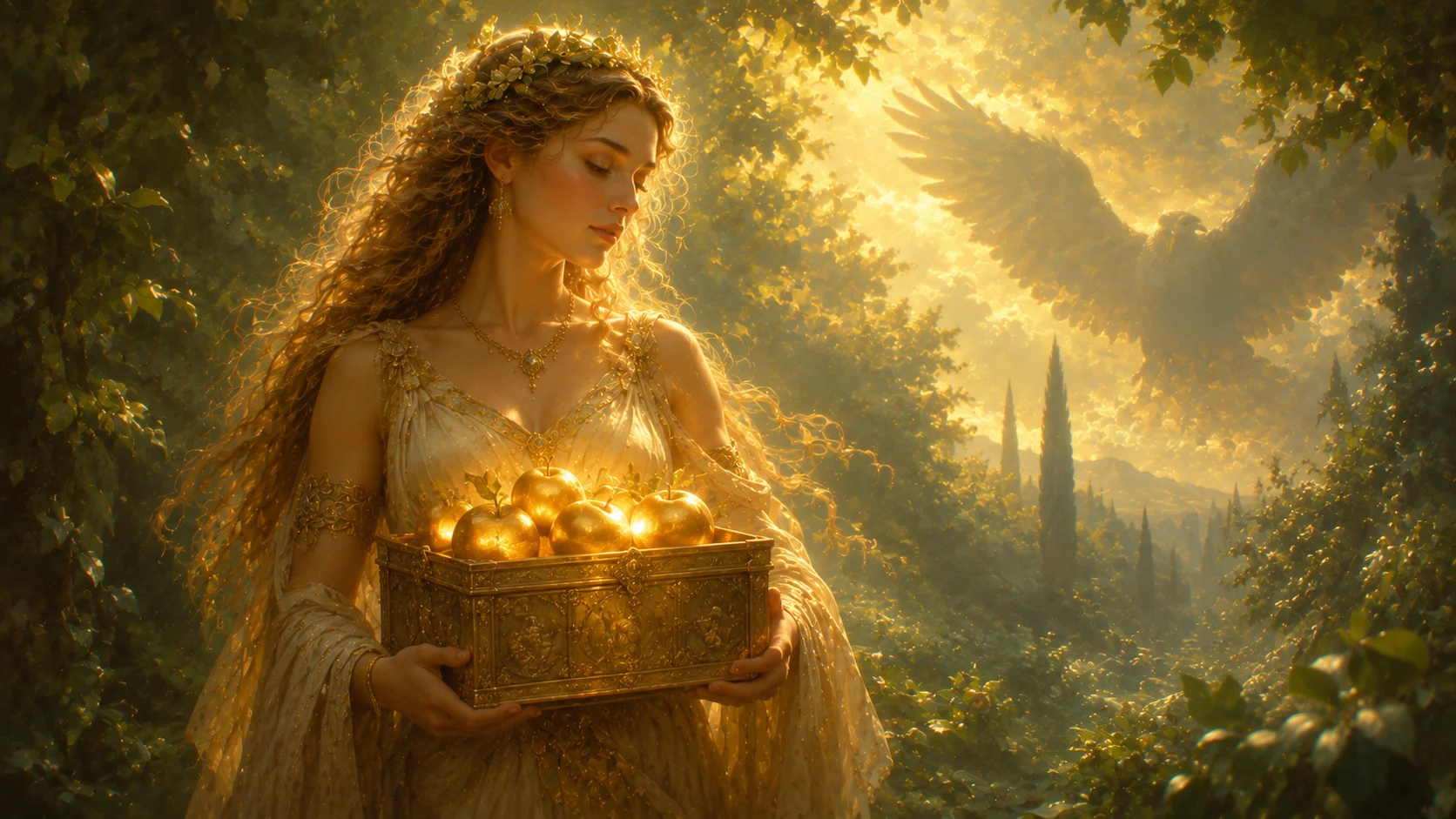
Idun (Old Norse Iðunn, “the rejuvenating one”) was an Aesir goddess and the wife of Bragi, the god of poetry. Her sacred charge was to guard a casket of golden apples, and from time to time to give them to the gods to eat — for these apples held the power of renewed youth, and it was by eating them that the Aesir kept themselves forever young and vigorous. Idun was thus, quietly, one of the most important deities of all: the gods' immortality itself rested in her keeping, and her gentle, faithful tending of the apples held back age and death from the whole divine race.
The Abduction by Thiazi
Idun's great myth tells how she was stolen away. The trickster Loki, to save his own skin, promised the giant Thiazi that he would lure Idun out of Asgard. By a trick, Loki coaxed her into a forest beyond the gods' walls, telling her he had found apples even finer than her own and asking her to bring her apples for comparison — whereupon Thiazi, in eagle form, swooped down and carried Idun and her apples away to his mountain home in the giants' land.
The Withering of the Gods
With Idun and her apples gone, catastrophe slowly fell upon the Aesir. Deprived of the fruit of youth, the gods began to grow old — their hair greyed, their skin wrinkled, their strength failed, and they shrank toward the decrepitude and death they had thought themselves beyond. It is one of the most striking images in Norse myth: the immortal gods themselves aging, brought low and feeble, all because the keeper of the apples had been taken. In their fear and weakness, the gods discovered that Loki was behind her loss and forced him, on pain of death, to bring her back.
The Rescue
Loki borrowed Freya's falcon cloak, flew to the giants' land, found Idun alone, and transformed her into a nut (or a sparrow), which he clutched in his talons and flew back toward Asgard with all speed. The giant Thiazi, discovering the theft, took eagle form and gave chase, the two birds streaking across the sky. As Loki neared Asgard, the gods kindled a great fire on the walls; Loki shot over it safely, but the pursuing eagle Thiazi, unable to halt, was caught by the flames, fell, and was killed by the waiting gods. Idun was restored, the gods ate her apples and their youth returned, and immortality was saved.
The Goddess on Whom Eternity Depends
Idun endures as the gentle goddess upon whom the immortality of all the gods depends — a quiet keeper whose loss nearly undid heaven itself. She embodies the Norse insight that even the gods' eternal youth is not a fixed possession but something tended and renewed, fragile enough to be stolen, and that without the constant gift of renewal, even the divine must age and fade. Her apples are among the most famous symbols of immortality in all of myth.
When the keeper of the golden apples was stolen away, the immortal gods themselves began to grey and wither — for even eternity, the Norse knew, must be renewed.