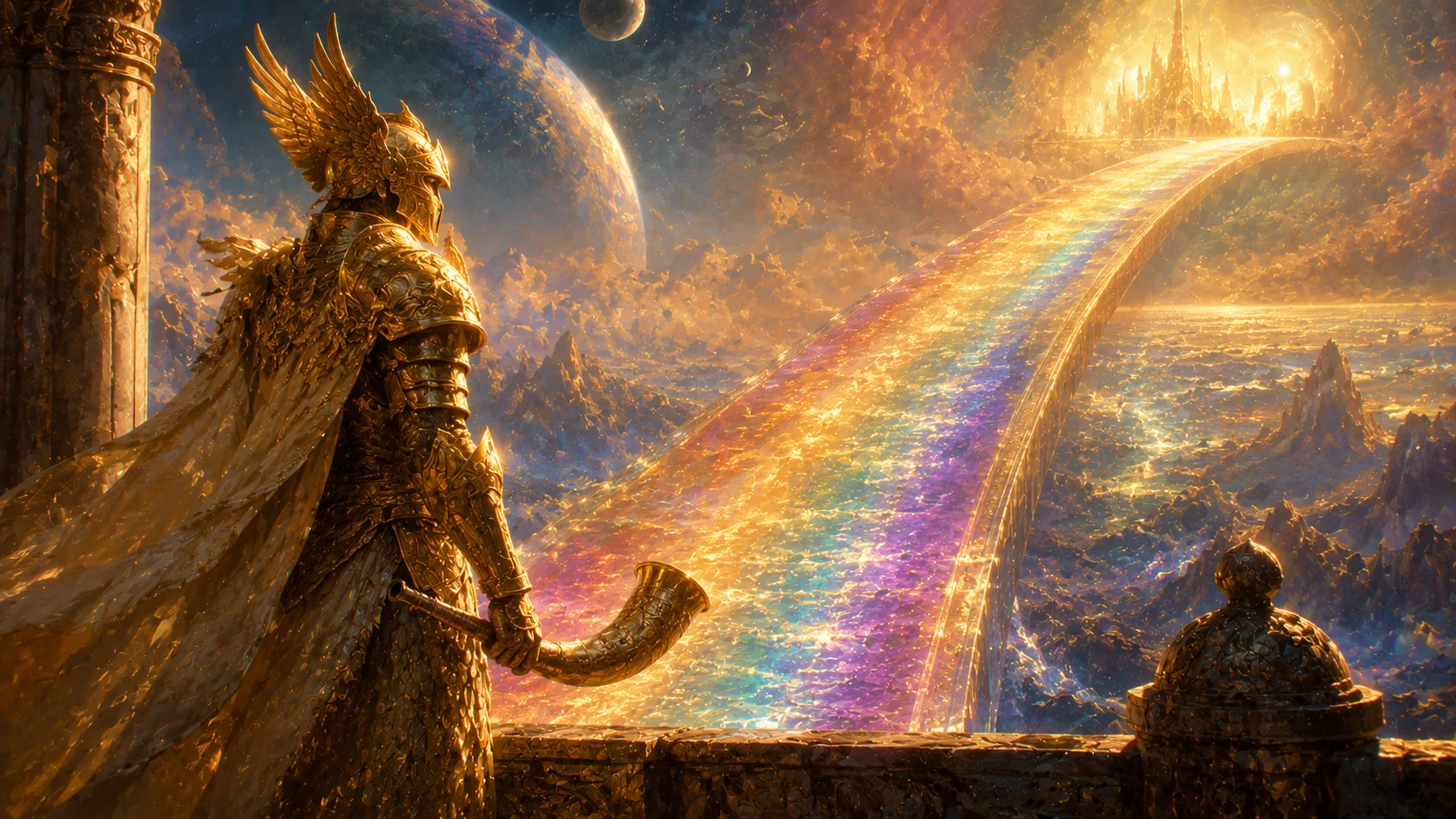
Heimdall was the watchman of the gods — the ever-vigilant guardian who stood at the rainbow bridge Bifröst, the gateway to Asgard, with senses so keen he could see to the ends of the world and hear the grass growing. The shining sentinel of the Aesir, born of nine mothers, keeper of the horn that will sound the end of the world, he is the eternal guardian whose final duty is to wake the gods for their last battle.
The Watchman of the Gods
Heimdall (Old Norse Heimdallr) was the guardian of Asgard, stationed at the head of Bifröst, the flaming rainbow bridge that connected the realm of the gods to the other worlds. His task was to keep watch against the giants and any enemy who might try to storm the gods' stronghold, and he was supremely suited to it: he needed less sleep than a bird, he could see for a hundred leagues by night as well as by day, and his hearing was so acute that he could hear wool growing on a sheep and grass growing in the earth. He was called the “whitest of the gods,” shining and golden-toothed, and he rode a horse named Gulltoppr (Golden-mane).
Born of Nine Mothers
Heimdall's origins were strange and marvelous: he was said to have been born of nine mothers — nine sisters, often understood as the daughters of the sea-god Aegir, the waves of the sea — a mystery that marked him as a being apart, perhaps connected to the world's very beginning. He was sometimes called the son of Odin, and was counted among the Aesir, the bright and faithful sentinel born from the meeting of land and the nine waves.
The Father of Mankind's Orders
In the poem Rígsþula, Heimdall, traveling among men under the name Ríg, visited the homes of three couples and fathered upon them the ancestors of the three classes of human society — the thralls (servants), the karls (free farmers) and the jarls (nobles). Through this, Heimdall was honoured as a kind of progenitor and orderer of human society, the god who established the ranks of mankind. It gave the watchman of the gods a second role as a shaper of the human world below.
The Gjallarhorn and the Last Battle
Heimdall's most fateful possession was the Gjallarhorn, the resounding horn whose blast can be heard throughout all the Nine Worlds. It was his solemn charge to sound this horn when the enemies of the gods finally came — and so, at the dawn of Ragnarök, it is Heimdall who will see the giants advancing and blow the Gjallarhorn with all his might, waking the gods and calling them to their final battle. In that last war, Heimdall is fated to meet his ancient enemy Loki — the two of them, watchman and trickster, faithful guardian and faithless schemer, will fight and slay each other, a fitting end to their long opposition.
The Eternal Sentinel
Heimdall endures as the archetype of the faithful guardian — the ever-watchful sentinel who never sleeps, the keeper of the gate and the sounder of the alarm. He embodies the Norse virtues of vigilance, duty and faithfulness, the god whose entire being is dedicated to watching against the coming of the end — and who, when it comes at last, will be the one to wake the world to face it.
He hears the grass grow and the wool lengthen on the sheep, and watches the rainbow road by day and night — so that when the giants finally come, his horn will wake the gods to their doom.