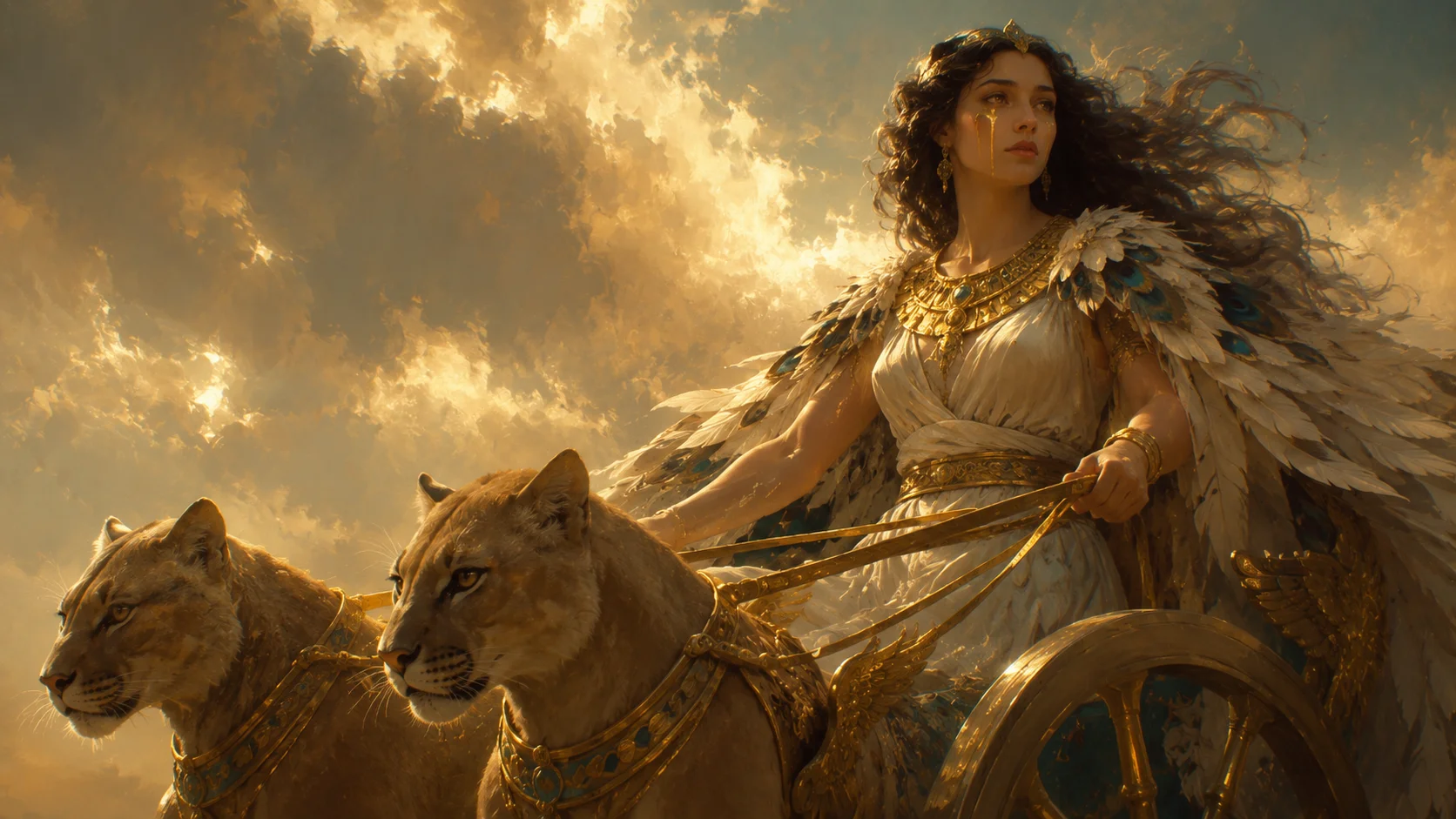
Freya was the great goddess of love, beauty, fertility, war and death — the most prominent and powerful of the Norse goddesses, foremost of the Vanir, mistress of magic, owner of a falcon cloak and a chariot drawn by cats, and the keeper of a hall to which fall half of all those slain in battle. Sensual and fierce, generous and grasping, she is a goddess of vast scope: desire and warfare, gold and sorcery, life and the dead all fall within her domain.
The Lady of the Vanir
Freya (Old Norse Freyja, “the Lady”) was a daughter of the sea-god Njord and the twin sister of the god Frey — one of the Vanir, the gods of fertility and prosperity who came to dwell among the Aesir after the war between the two divine races, sealed by an exchange of hostages. The most beautiful of all the goddesses, Freya was the deity of love and desire, of sexual freedom, of fertility and abundance, and she was invoked in matters of the heart and of childbirth. She was married to a mysterious god named Óðr, who often wandered far away, and she wept tears of red gold in her longing for him.
The Necklace Brisingamen
Freya's most famous treasure was the necklace Brísingamen, a marvel of golden craftsmanship forged by four dwarves — from whom she won it, the tale says, by spending a night with each. The shining necklace was the emblem of her beauty and her power, and Loki once stole it from her (in the form of a fly and a seal, in a tale of theft and recovery). She also possessed a cloak of falcon feathers that allowed its wearer to fly between the worlds, which the other gods sometimes borrowed, and she rode in a chariot pulled by two great cats.
Mistress of Magic and the War-Slain
Freya was the great mistress of seidr, the powerful Norse magic of prophecy and shaping fate — indeed it was Freya who first taught this magic to the Aesir, including to Odin himself. And though we think of her first as a goddess of love, she was equally a goddess of war and death: she rode to battle and claimed the slain, and it was said that half of those who died in combat went not to Odin's Valhalla but to Freya's own hall, Fólkvangr (“the field of the host”), where she received them. She had first choice of the battle-dead, before even the All-Father.
The Goddess the Giants Coveted
Freya's beauty made her the great prize that the giants forever schemed to possess. When a giant builder bargained to construct Asgard's wall, his price was Freya, the sun and the moon; when the giant Thrym stole Thor's hammer, his ransom was Freya as his bride. Again and again the gods had to scheme and fight to keep her from the hands of the jötnar — for to lose Freya would be to lose love, beauty and fertility themselves from the world. She was too precious to give up, and too desired ever to be left in peace.
The Great Goddess of the North
Freya endures as the supreme goddess of Norse myth — a deity of extraordinary range, encompassing love and lust, beauty and gold, magic and prophecy, war and the claiming of the dead. She gives her name (with Frigg) to Friday. She embodies the Norse refusal to divide the feminine divine into the merely gentle: Freya is desire and death together, the goddess who is at once the most beautiful and the most formidable, who loves fiercely and claims the slain, mistress of the deepest magic and the most coveted treasure in all the Nine Worlds.
Half the battle-slain are hers before ever Odin chooses — for Freya is love and war in one, the most beautiful of the goddesses and the most dangerous to cross.