
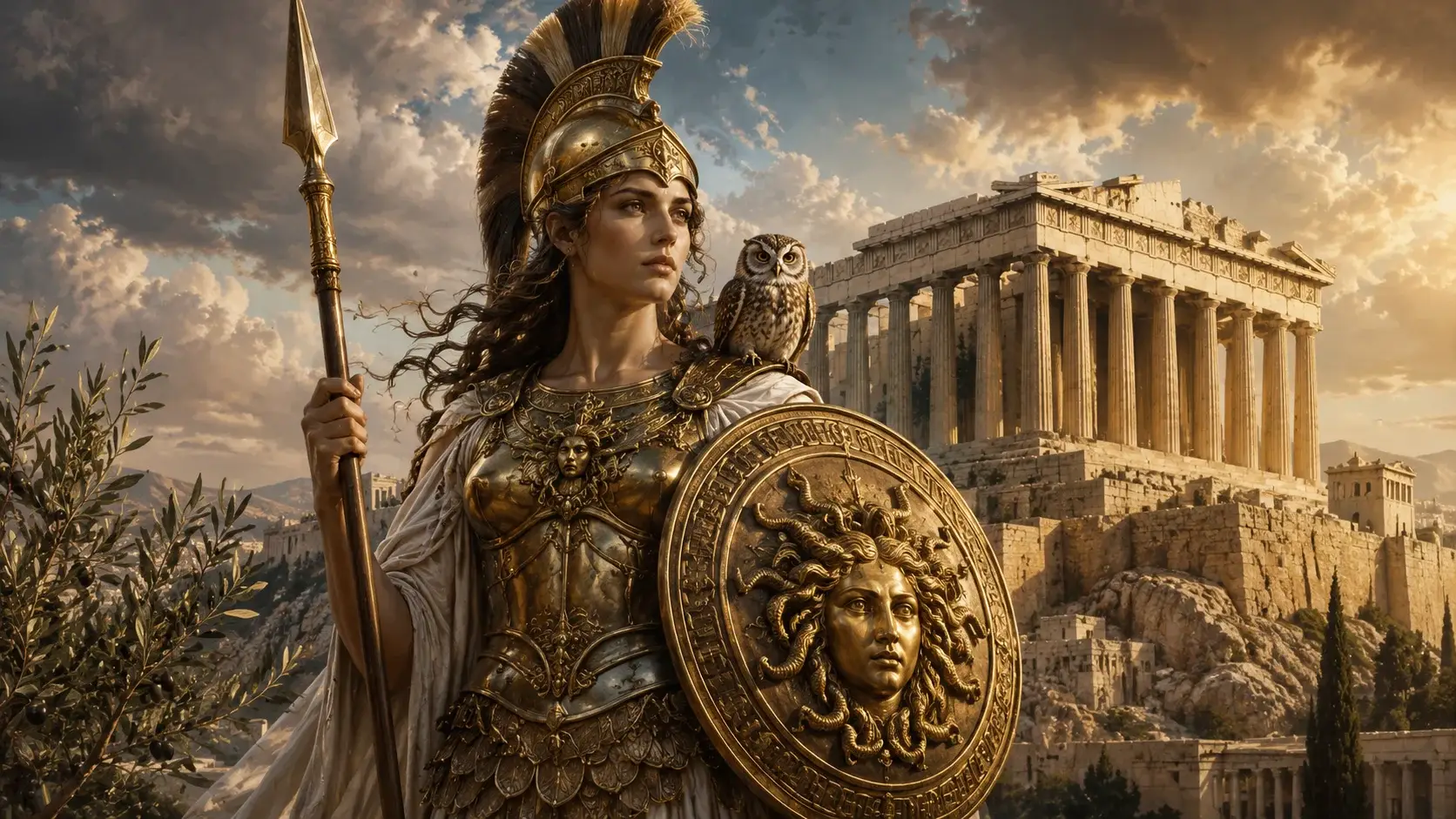
She was born without a mother, fully grown and clad in armour, from the splitting of a god's skull — and from that impossible birth onward, Athena was the mind of Olympus made divine. Goddess of wisdom, of strategic war, of crafts and the just cause, she was the Greek ideal of intelligence as a force more powerful than brute strength. Where her half-brother Ares was the madness of battle, Athena was the cold clarity that wins it.
Born of Thought, Not of Womb
Zeus had been warned that the child of the wisdom-titan Metis might overthrow him, so he swallowed Metis whole. But the child grew within him — and one day Zeus was seized by a splitting headache so terrible that Hephaestus cleaved his skull with an axe. Out leapt Athena, full-grown, armed and crying a war shout. She was, from her first breath, wisdom that arrives ready for the fight.
Wisdom Armed for War
Athena bore the aegis and the spear, but she was no lover of slaughter. She governed the strategy of war — the planning, the discipline, the just cause — and the arts of peace as well: weaving, pottery, the olive, the bridle that first tamed the horse. To the Greeks, civilisation itself was Athena's gift.
The City She Won
When she and Poseidon both desired the greatest city of Attica, the people asked each god for a gift. Poseidon struck the rock and gave them a saltwater spring; Athena planted the first olive tree — food, oil, wood, and peace. The people chose her, and the city took her name: Athens. Her great temple, the Parthenon, still crowns its hill.
The Goddess of the Just Cause
Athena was the patron of heroes who won by wit as much as force: she guided Perseus against Medusa, steadied Heracles through his labours, and above all favoured clever Odysseus, whose cunning mirrored her own. Yet she could be terrible when her honour was slighted — the weaver Arachne, who dared claim greater skill, was transformed into the first spider, doomed to weave forever. Wisdom, Athena's myths insist, is to be revered — never mocked.
The owl that turns its head in the dark to see what others miss has been her emblem for three thousand years.