
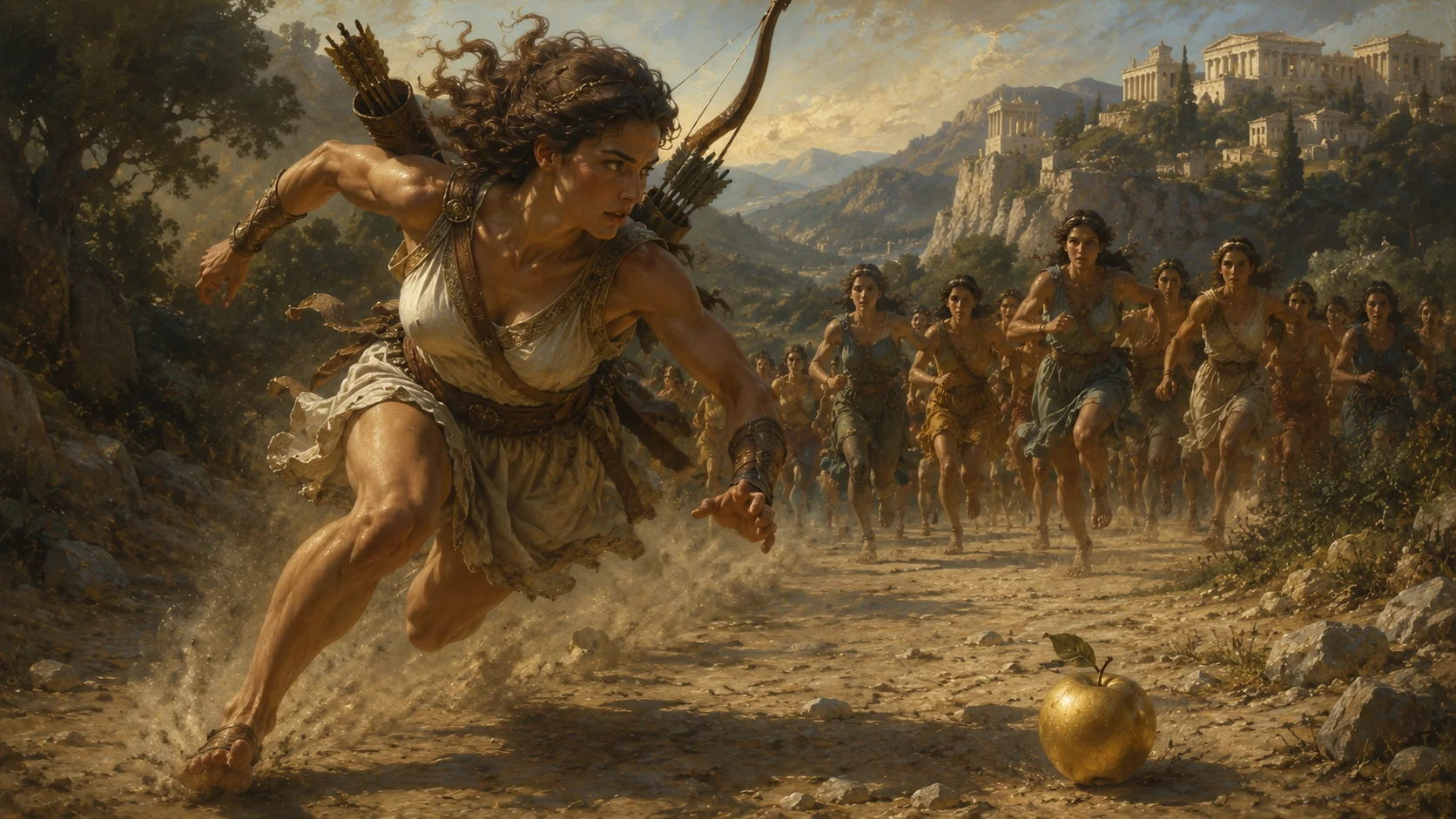
Atalanta was the great heroine of Greek myth — a huntress as swift and deadly as any man, who drew first blood on a monstrous boar, sailed (in some tellings) with the Argonauts, and would only marry a man who could outrun her. In a mythology dominated by male heroes, she stands as the woman who beat them at their own games.
The Abandoned Girl Raised by a Bear
Exposed on a mountainside as an infant by a father who wanted a son, Atalanta was suckled by a she-bear sent by Artemis and raised by hunters. She grew into a peerless huntress and athlete, sworn to virginity in devotion to Artemis, wild and self-sufficient in a way few women in myth were allowed to be.
The Calydonian Boar
When a gigantic boar sent by Artemis ravaged Calydon, the greatest heroes of Greece gathered to hunt it — and it was Atalanta who drew first blood, landing the first arrow before any man. The hero Meleager, who loved her, awarded her the prize of the hide, sparking a deadly quarrel. Again and again, Atalanta proved herself the equal or better of the male heroes around her.
The Race for Her Hand
Pressed to marry, Atalanta set a deadly condition: any suitor must beat her in a footrace, and those who lost would be put to death — and she was faster than them all. Many died. Then Hippomenes (or Melanion) prayed to Aphrodite, who gave him three irresistible golden apples. During the race he dropped them one by one; each time Atalanta paused to pick up the gleaming fruit, and so lost just enough ground to be beaten. She married him — outrun at last, not by speed, but by temptation and a goddess's trick.
The Heroine Among Heroes
Atalanta endures as Greek myth's great answer to the question of whether a woman could be a hero. Swift, fierce, and free, she ran with the best of them and beat most — a wild huntress who refused, for as long as she could, to be anything but herself.
She would only be won by a man who could outrun her — and in the end, it took three golden apples and a goddess to do it.