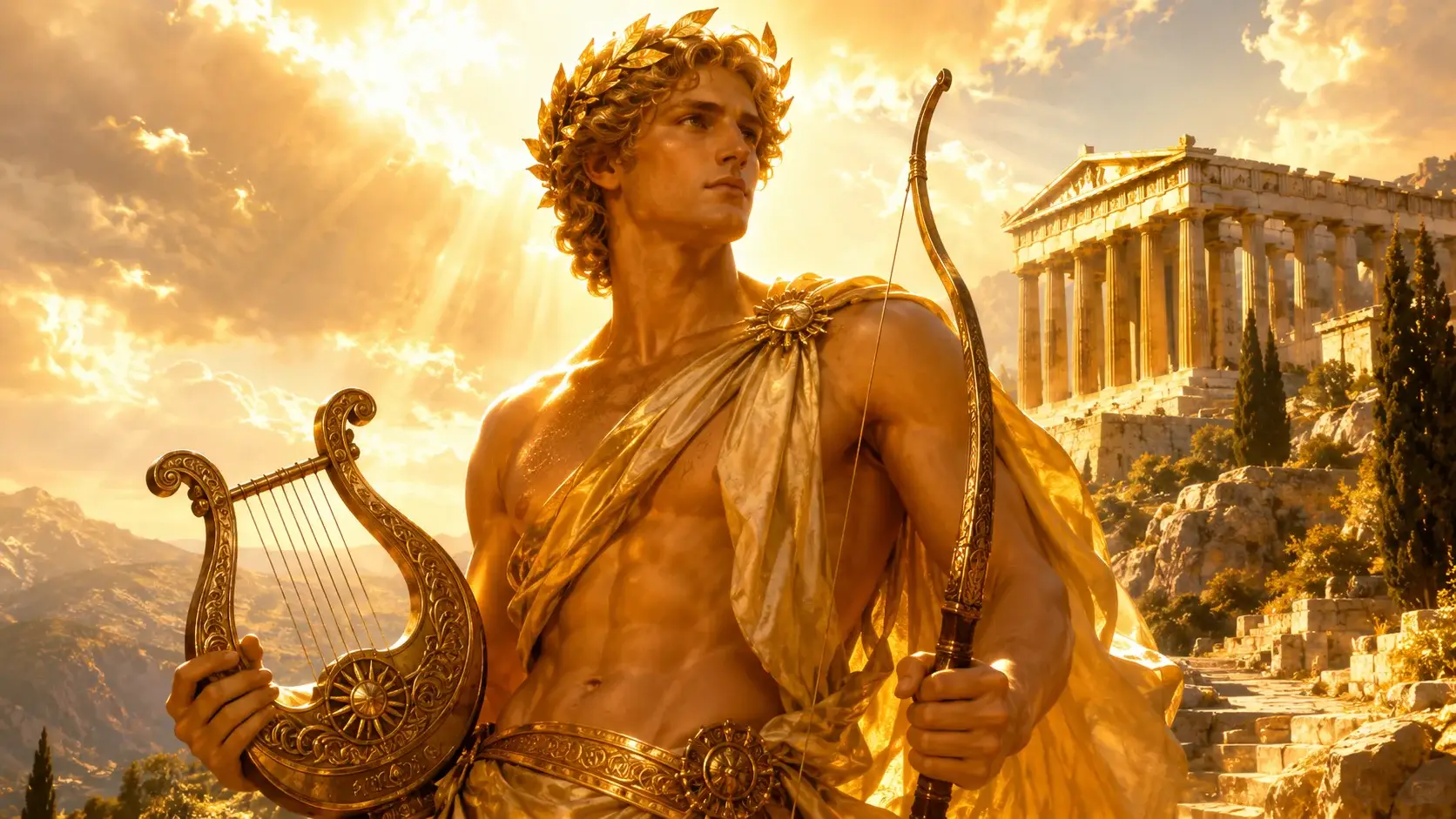
Apollo was the most luminous of the Greek gods — and the most double-edged. He was light and music and healing and prophecy, the golden ideal of harmony and reason. He was also the archer whose silent arrows brought plague, the god whose oracle spoke truths that destroyed the men who heard them. To the Greeks, Apollo was proof that beauty and terror are often the same god wearing two faces.
The Twin Born on a Floating Island
His mother Leto, pregnant by Zeus, was hunted across the world by a jealous Hera who forbade any solid land to give her shelter. Only the floating island of Delos dared receive her, and there Leto bore twins: Artemis first, then Apollo. Delos was anchored to the sea-floor in gratitude and became one of the holiest places in the Greek world.
Slayer of the Python, Lord of Delphi
While still young, Apollo travelled to Delphi and slew the monstrous serpent Python that guarded the place. Over its sacred chasm he founded his oracle, where the priestess — the Pythia — spoke his prophecies in riddling words. For a thousand years, kings and commoners alike journeyed to Delphi to ask the god what the future held. Carved at its entrance: Know thyself.
The God of Music and the God of Plague
Apollo's lyre made the music of the spheres; he led the nine Muses and embodied poetry, reason and proportion. Yet the same hand drew a bow whose arrows carried pestilence — the opening of Homer's Iliad shows Apollo striding down from Olympus “like the night,” loosing plague upon the Greek camp. Healer and harm-bringer, he held both gifts; the Greeks understood that the power to cure is the power to kill.
Loves and Losses
For all his radiance, Apollo's loves ended in grief. He pursued the nymph Daphne, who prayed to escape him and was transformed into a laurel tree — whose leaves he wore ever after in mourning. He accidentally killed his beloved Hyacinthus with a discus, and from the boy's blood raised a flower. The brightest god carried the longest shadows.
At Delphi the laurel still grows, and the old riddle still waits: know thyself — if you dare.